
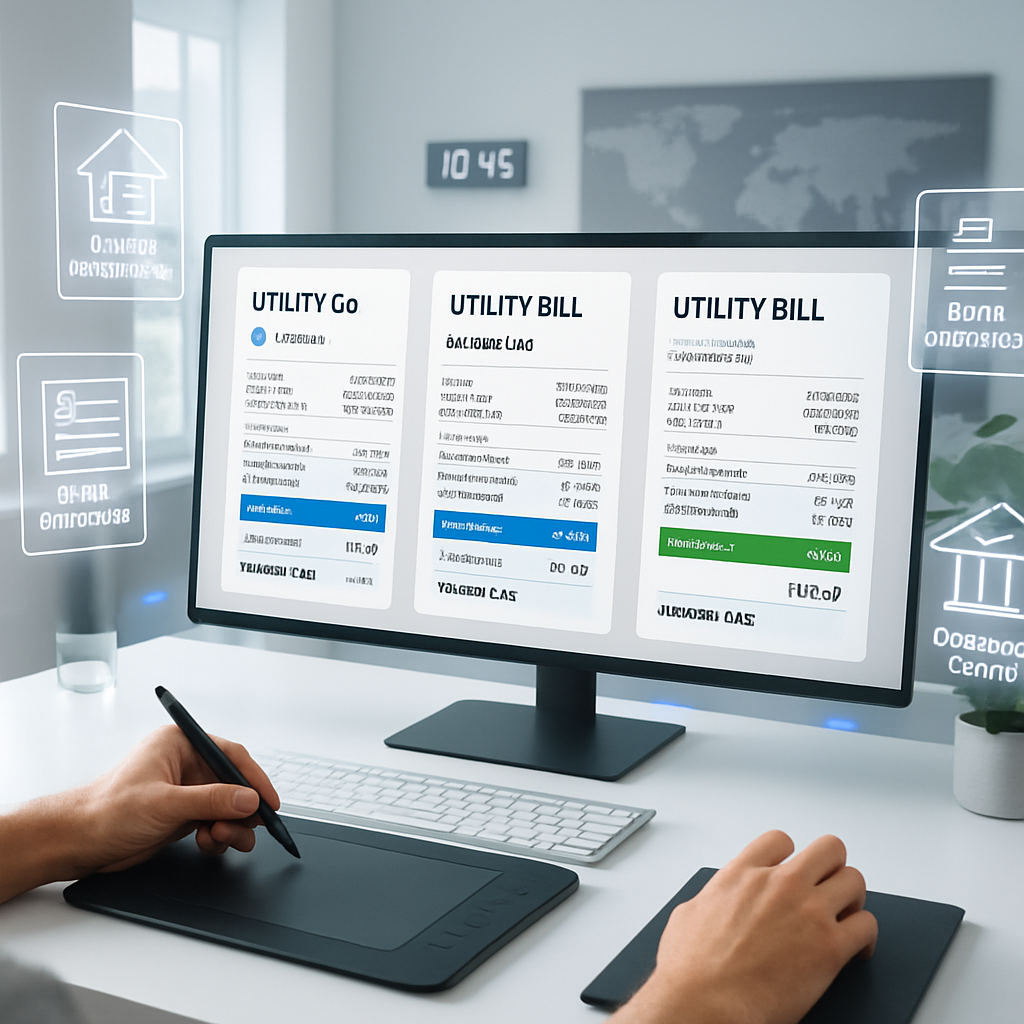
Creating accurate and consistent utility bill for proof of address documents can be challenging without the right tools. Editable utility bill templates streamline this process by offering customizable layouts that fit regional formats and include key details like account information and billing periods. This ensures speed, design accuracy, and professional presentation, eliminating the need to start from scratch each time.
Understanding the variety of accepted proof of address documents—from tenancy agreements to government letters—helps tailor each editable template to specific verification scenarios. Let’s explore how these adaptable address verification templates can simplify preparing compliant documents across different countries and institutions while maintaining uniform formatting for quick updates.
Next, you’ll learn how to customize headers, tables, and branding elements in editable utility bill templates to match local formats and enhance clarity. These templates are intended for design practice, mockups, and film props; they are not substitutes for official documents.
Utility bills remain the most commonly accepted documents for proof of address worldwide, yet acceptance rules differ by region and institution. Using editable templates tailored to local formats can simplify creating compliant, professional address verification documents quickly.
- Identify accepted proof of address types: Understand that alongside utility bills, documents like tenancy agreements, bank statements, and government letters may also be valid.
- Adapt to regional variations: Customize templates to meet the specific criteria and formats required by different countries or organizations.
- Leverage editable utility bill templates: Use ready-to-edit files to efficiently produce accurate address proofs without starting from scratch.
- Ensure layout consistency: Maintain uniform formatting for quick updates and professional presentation across various document versions.
- Address diverse verification needs: Tailor content fields such as account details, billing periods, and customer information to match verification purposes.
- Streamline address verification processes: Editable templates help reduce errors and speed up preparation for compliance with address proof requirements.
- Benefit from local provider designs: Incorporate recognizable utility company branding to enhance document authenticity and acceptance chances.
Next, you’ll learn how to customize headers, table data, and security features in editable templates to suit different address verification scenarios. These templates are designed for responsible use such as design practice and mockups; they are not substitutes for official documents.
Commonly Accepted Proof of Address Documents
One of the most versatile and widely recognized document types used for address confirmation are editable utility bill templates. These templates replicate official bills, allowing users to quickly input relevant information such as the customer’s name, address, account number, and billing dates without starting from scratch. This approach not only saves time but also provides a consistent format recognized by many institutions.
Utility Bills as Primary Proof of Address
Utility bills typically include key data points like service provider details, billing period, and amount due, which authenticate the link between the individual and the address. When using editable templates, it is important to replicate these elements precisely to maintain a professional appearance that aligns with common utility bill standards.
Other Valid Document Types
- Tenancy agreements—often used as complementary proof in rental situations
- Bank statements proof of address—showing transactional history linked to an address
- Government-issued letters and residence certificates—offering official confirmation from authorities
Mastering editable utility bill templates enables users to streamline document preparation while understanding alternative documents is essential for diverse verification contexts. This foundation leads well into appreciating regional differences in utility bill formats and requirements.
Regional Variations in Proof of Address Requirements
Country-Specific Utility Bill Formats
Editable document templates must account for the fact that utility bill layouts and essential content vary widely from country to country. For example, North American templates often emphasize specific utility company branding and clear billing cycles, while European versions might include regulatory notices or multilingual labels. Asian utility bills sometimes incorporate QR codes or digital authentication details, reflecting different technological adoption levels.
When customizing templates, incorporating these local quirks ensures that the document resonates with regional expectations and reduces the risk of rejection due to formatting anomalies.
Institutional Policies and Acceptance Criteria
Beyond geographical differences, individual organizations may require specific details or formatting for acceptance. Banks or governmental bodies, for instance, might reject documents lacking notarized sections or clear verification codes. Editable templates designed with modular sections allow quick adjustment of these features to meet varying institutional demands.
To streamline compliance, consider using editable US utility bill templates tailored to capture required local details, avoiding time-consuming redesigns.
Understanding these dimensions enhances your ability to craft adaptable templates and sets the stage for leveraging their advantages.
Advantages of Using Editable Utility Bill Templates
Time Efficiency and Accuracy
Editable templates allow rapid data entry, shortening document creation times by up to 30% in practical scenarios. They reduce common errors such as misaligned tables or misspelled fields by employing locked layout areas and preformatted text boxes.
Customization for Compliance
- Templates offer flexibility to adjust headers, footers, and account details to match specific verification needs.
- Billing periods, customer info, and payment sections can be tailored easily without altering the overall design.
Maintaining Uniform Formatting
Consistent typefaces, spacing, and alignment improve document legibility and professional appeal, crucial for acceptance. Using layered file formats like PSD or Word with style templates helps maintain this consistency across batches of documents.
For a ready-to-adapt starting point, explore our editable utility bill template collection, which combines ease of editing with professional layouts.
Next, consider how to make these templates even more credible by aligning them with local utility provider branding.
Customizing Templates for Local Provider Branding
Incorporating Recognizable Utility Company Elements
Authenticity is enhanced by embedding official-looking logos, consistent color schemes, and common design motifs associated with known utility companies. Editable PSD and Word files facilitate layering logos separately, allowing you to swap in region-specific images or branding elements quickly.
This approach not only helps the document appear more credible but also meets institutional expectations that often rely on brand recognition to vet proof of address documents.
Examples of Regional Utility Bill Templates
- United Kingdom Thames Water—with its distinct blue and white visual style and verified logo placement
- France SOSH—featuring detailed service usage tables and French regulatory disclaimers
- Canada Utility Bill—incorporates bilingual text and region-specific utility provider branding
For practical examples and to jumpstart your project, visit our UK Thames Water editable template, showcasing precise layout and brand integration.
With branding integrated, focus next on practical editing techniques to fine-tune these templates efficiently.
Step-by-Step Guide to Editing Utility Bill Templates
Modifying Headers and Contact Information
- Identify and replace all placeholder text with authentic customer data, including full name and address details.
- Update the utility provider section with local company name, contact numbers, and billing address to comply with regional standards.
Adjusting Table Layout for Billing Data
- Ensure tables for billing periods, usage quantities, and charges have clearly defined columns with uniform cell sizing.
- Apply bold or contrasting colors to key totals, making summaries straightforward for reviewers.
Enhancing Security Features for Design Accuracy
While these templates are not official documents, adding design elements such as subtle watermarks, barcodes, or disclaimer text can improve their professional appearance in mockups or practice environments. Ensure these do not imply legal validity but serve as aesthetic enhancements aligning with genuine document traits.
Comprehensive editable examples are available in our full editable templates shop, supporting a variety of use cases.
Legal & Ethical Use
- Editable templates are intended strictly for design practice, mockups, and educational demonstrations.
- They must not be used as substitutes for official proof of address documents in any legal, financial, or institutional capacity.
- Users should always adhere to relevant local laws and institutional guidelines when editing or employing these templates to ensure responsible use.
Conclusion
Editable utility bill templates serve as invaluable tools for creating consistent and accurate proof of address documents across diverse regional and institutional contexts. By incorporating local utility branding, maintaining uniform formatting, and allowing quick customization of key data points, these templates significantly streamline document preparation without sacrificing clarity or professionalism.
Their flexibility not only reduces errors and saves time but also adapts to various country-specific format nuances and organizational requirements. Leveraging thoughtfully designed editable templates empowers users to produce documents that align with the expectations of different verification scenarios while preserving design integrity.
As you integrate these templates into your workflow, challenge yourself to refine each detail—whether it’s localizing utility provider elements or enhancing table layouts—to ensure a seamless balance between efficiency and quality. This ongoing attention to customization and precision fosters reliable, reusable documents that meet evolving needs with confidence and ease.